
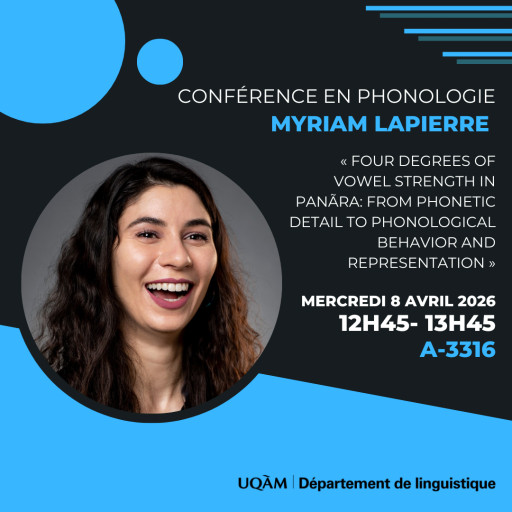
«Four Degrees of Vowel Strength in Panãra» par Myriam Lapierre
Conférencière : Myriam Lapierre (Université McGill)
Titre : Four Degrees of Vowel Strength in Panãra: From Phonetic Detail to Phonological Behavior and Representation
Résumé :
Linguistic theory has long treated the segment as the basic unit of phonological representation. Q Theory challenges this assumption by decomposing segments into sequences of quantized subsegments (e.g., Shih & Inkelas 2019). Building on this framework, I propose an extension of Q Theory that captures differences in vowel strength.
I define segment strength as a cluster of phonological properties that together determine a segment’s resistance to processes that neutralize contrasts or simplify structure. Traditionally, strength effects have been modeled using a heterogeneous set of representational devices—such as input specification and moraicity—often treating related phenomena as independent. By contrast, I develop a unified account in which vowel strength is encoded directly in subsegmental structure. Specifically, vowels are represented along a monotonic, four-point scale: stronger vowels are composed of more subsegments, while weaker vowels contain fewer. This approach predicts both that some languages may exhibit a four-way strength contrast and that strength relations are strictly hierarchical: segments with fewer subsegments always pattern as weaker than those with more.
Weakest vowels | (v) (v v) (v v v) (v v v v) | Strongest vowels
I test this proposal with data from Panãra (Jê; ISO: kre), which exhibits a four-way distinction among phonemically long vowels, short vowels, epenthetic vowels, and excrescent vowels (Garvin et al. 2020; Schwarz et al. 2019). Long and short underlying vowels are represented with four and three subsegments, respectively. Epenthetic vowels—inserted to resolve codas and characterized by a fixed, default quality—are represented with two subsegments. Excrescent vowels, represented with a single subsegment, arise within onset clusters, display context-dependent quality, and are unable to head a syllable. Across multiple diagnostics, underlying vowels consistently outrank inserted vowels; within each class, a further binary distinction emerges, yielding the predicted four-level hierarchy.
Empirical support for this analysis comes from both detailed phonological patterning and phonetic evidence. I draw on a detailed phonological description of the language (Lapierre 2023a,b), as well as two experimental studies: one examining the contrast between phonemically short and long vowels (Lapierre et al. 2025), and another investigating the properties of excrescent vowels (De Falco et al. 2026).
Date / heure
Lieu
Montréal
Renseignements
- Richard Compton
- compton.richard@uqam.ca